
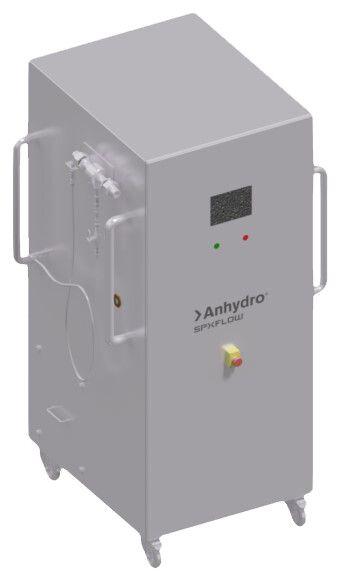
Anhydro Dosing System for Gas Injection | Anhydro
he Anhydro Dosing System provides accurate CO2 or N2 gas injection for consistent powder quality in food, dairy, pharma, and chemical production.
Benefits
- Homogeneous powder bulk density
- Precise control of essential powder properties
- Wide range of gas dosing capacities
- High accuracies – even in dosing rates as low as 30 g CO2/h / 1.2 oz CO2/h
- Three control modes – manual, fixed flow rate and proportional flow rate
- Available up to 500 bar / 7,252 psi (standard 300 bar / 4,351 psi)
- PLC integration
- Suitable for multiple products
- Remote access available for site support
- Dosing after the high pressure pump (high pressure dosing)
- Simple installation and operation
- Minimum maintenance requirements
- Compact and mobile design
- Option: Hygenic Design - CIP’able version
| Product | Dosage Guide Value* [%] |
Bulk Density |
Brightness | Particle Size |
Flowability | Solubility | Foaming |
|---|---|---|---|---|---|---|---|
| Soluble Coffee | 0.2-1.2 | X | X | X | |||
| Coffee Whitener | 0.2-0.6 | X | X | X | |||
| Foamer | 0.3-0.8 | X | X | X | |||
| Ice Coffee (90% Sugar) |
0.3-0.6 | X | X | ||||
| Sweetener | 0.1-0.5 | X | X | ||||
| Infant Formulae | 0.1-0.3 | X | X | ||||
| Malt and Mixed Malt Products |
0.2-1.5 | X | X | X | |||
| Ovomaltine | 0.2-1.0 | X | X | ||||
| Chocolate Drink | 0.1-0.9 | X | X | ||||
| Caramel | 0.1-0.6 | X | X | ||||
| Cocoa Drink | 0.1-0.7 | X | X | X | |||
| Milk Powder | 0.1-0.3 | X | X | X | X | ||
| Sugar Products | 0.1-2.0 | X | X | X | |||
| Plant Extracts | 0.1-2.5 | X | X | X | X |
The Anhydro Dosing System is equipped with a dual supply inlet for gas, which enables switching between the two gas supply tanks without interruption. When supplied, the gas is filtered and is passed through a heat exchanger for temperature control.
Gas Dosing Process
The pressure of the gas is boosted in a high-pressure piston membrane pump. Accurate flow control is achieved by passing the gas through a mass flowmeter. A valve system ensures compliance with safety and venting requirements.
The gas is then directed to the injection nozzle in the dryer product feed line via a flexible hose. The injection nozzle can be positioned minimum 1 meter from the dryer high pressure feed pump and minimum 5 meters from the atomizer nozzle outlets.
The injection unit control system features three control modes: manual, fixed flow rate and proportional flow rate. In the proportional flow rate mode the injection unit mass flowmeter and the flowmeter installed in the feed line are interconnected via the in-house control system and the Anhydro Dosing System control system.
High-Pressure Gas Injection Into Milk Concentrate
The ability of gas to lower milk powder bulk density is governed by the solubility of the gas in the water component of the milk concentrate. The dissolved gas is released from the water component at the point of atomization, forming vacuoles within the individual milk powder particles. Thereby, the particles are “ballooned”, thus reducing the overall bulk density of the powder. The end product is defined by a controlled combination of the quantity of gas, the atomizer nozzle pressure, the feed temperature and viscosity, drying temperature etc.
Benefits and features when using N2 / CO2
| Product | Dosage GuideValue* [%] | BulkDensity | Brightness | ParticleSize | Flowability | Solubility | Foaming |
|---|---|---|---|---|---|---|---|
| Soluble Coffee | 0.2-1.2 | X | X | X | |||
| Coffee Whitener | 0.2-0.6 | X | X | X | |||
| Foamer | 0.3-0.8 | X | X | X | |||
| Ice Coffee(90% Sugar) | 0.3-0.6 | X | X | ||||
| Sweetener | 0.1-0.5 | X | X | ||||
| Infant Formulae | 0.1-0.3 | X | X | ||||
| Malt and MixedMalt Products | 0.2-1.5 | X | X | X | |||
| Ovomaltine | 0.2-1.0 | X | X | ||||
| Chocolate Drink | 0.1-0.9 | X | X | ||||
| Caramel | 0.1-0.6 | X | X | ||||
| Cocoa Drink | 0.1-0.7 | X | X | X | |||
| Milk Powder | 0.1-0.3 | X | X | X | X | ||
| Sugar Products | 0.1-2.0 | X | X | X | |||
| Plant Extracts | 0.1-2.5 | X | X | X | X |
Industries
Interested in Anhydro Dosing System for Gas Injection | Anhydro?
Talk to our engineering team about specifications, lead times, and configuring this equipment for your process.
Request a Quote